
What to Check in a Chinese Perfume Factory: Five Mistakes Men's Brands Make
A factory visit is the cheapest piece of due diligence available to a fragrance brand, and most visits produce almost nothing because the visitor asks for impressions instead of records. Five checks turn a tour into evidence: the batch record trail, the retained reference standard, the weighing and batching controls, the filling line's in-process checks, and the documentation the factory can release to you. Run those and a men's line becomes a manageable project. Skip them and you will have a pleasant afternoon and a quotation you still cannot compare.
Key takeaways
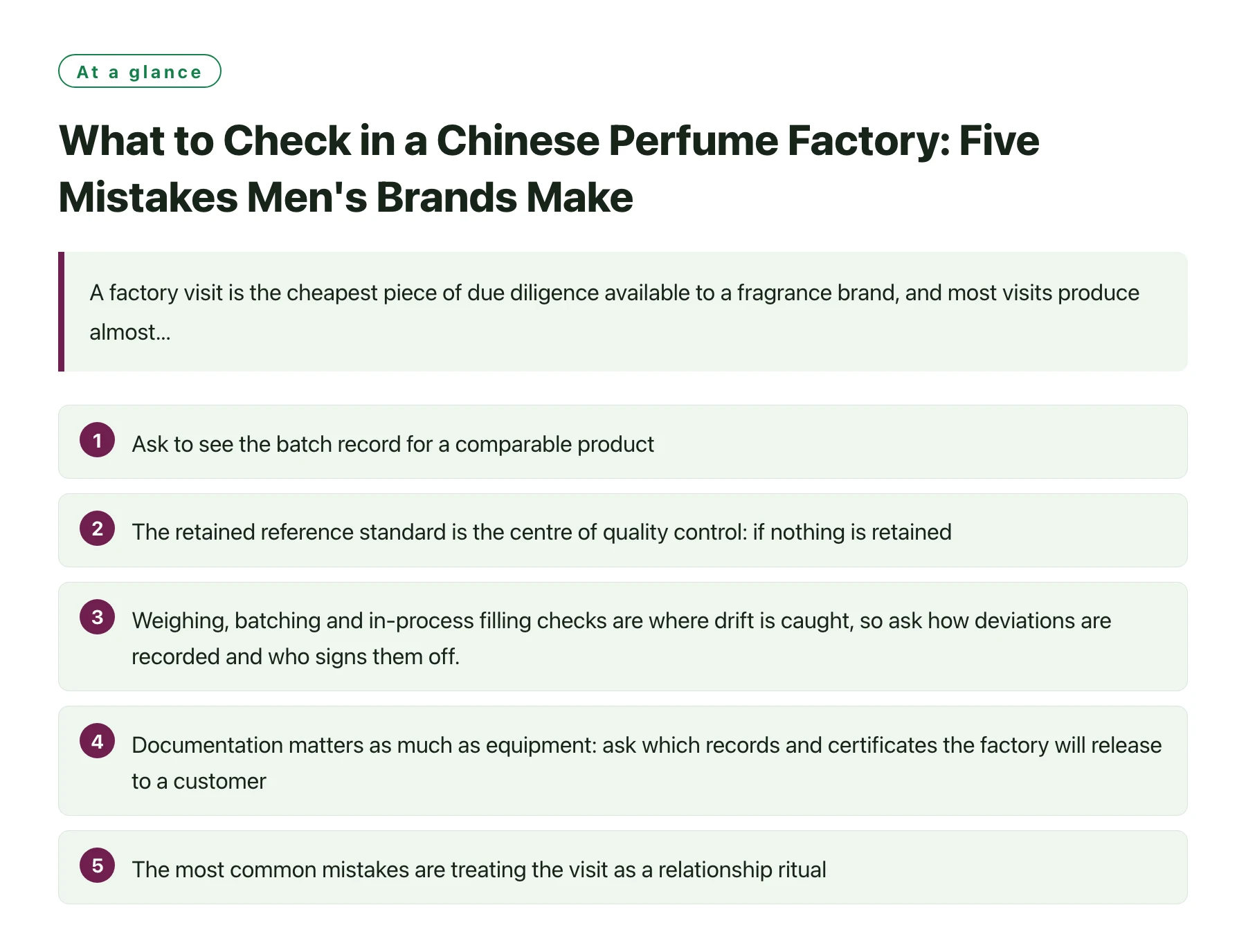
- Ask to see the batch record for a comparable product, not the showroom and not the newest line.
- The retained reference standard is the centre of quality control: if nothing is retained, production has nothing to be compared against.
- Weighing, batching and in-process filling checks are where drift is caught, so ask how deviations are recorded and who signs them off.
- Documentation matters as much as equipment: ask which records and certificates the factory will release to a customer, not which ones it holds.
- The most common mistakes are treating the visit as a relationship ritual, being impressed by equipment, and leaving without a written follow-up list.
Factory visits are usually framed as a chance to build trust. That is true, but trust is not evidence, and a fragrance project is decided by records. The visit is the one moment when a brand can ask to see how production actually documents itself.
For a men's line the stakes are specific. Bottles are often dark, formats are often larger, and the product may sit on a shelf or in a warehouse for months before the customer meets it. Quality failures in that setting look like a weak opening or a dull dry-down rather than a broken unit, so the checks that matter are the ones that detect drift early.
What follows is a short, practical sequence for a visit, and the five habits that make visits useless.
What a visit can and cannot prove
A visit can prove that a factory exists, that it runs the processes it claims, and that its staff can answer technical questions without leaving the room. It cannot prove that a future order will be produced to your reference, and it cannot substitute for an independent test report on the finished product.
That is why the goal of a visit is not reassurance but a list of evidence you can check afterwards. The three questions worth writing down before you arrive are: which comparable product was made most recently, what the retained standard for it is, and which records the factory is willing to release. It also helps to look at how the factory presents finished programmes, because Xuelei case studies show the shape a project takes once it leaves the quotation stage.
Third-party testing has a published scope
Independent laboratories publish the categories of cosmetic and personal care testing they perform, which is a useful reference for what verification outside the factory can and cannot cover [1]. Knowing that scope in advance stops a visit from turning into a negotiation about which tests are necessary. It is also worth asking whether the plant is a a factory that handles fragrance R&D and production in one programme or only a filling site, because that answer decides how many questions you need to take elsewhere.
Two checks that matter when the product will be exported
In the European Union the main legal obligations rest on a responsible person established in the Union, so an exporter needs to know who will hold that role before the first shipment, and which product information has to be available to authorities on request [2]. This is a question to settle during the visit, not after the goods are booked.
Fragrance materials are restricted individually and per product category. The factory should be able to name the restriction status of the materials in your formula without leaving the room to look it up [3], and it should be willing to put that answer into the document list you take away.
Six checks that produce evidence
- Ask for a recent batch record on a comparable productNot a sample batch and not the flagship line, but something close to what you intend to order. Look for signatures, timestamps and any handwritten correction with an initial next to it.
- Inspect the retained reference standardAsk to see the sealed reference that production is compared against, how it is stored and how long it is kept. A factory with a functioning retention system can show it in two minutes.
- Watch the weighing and batching areaThis is where restricted materials and expensive absolutes are measured. Ask how scales are calibrated, how the operator confirms the material identity, and what happens when a weight is out of tolerance.
- Follow one unit down the filling lineTrace a bottle from filling to crimping, decoration and packing. Ask which in-process checks are performed and what the rejection rule is at each station.
- Ask who signs the releaseFind out the name of the person who authorises a batch for shipment, and whether the same person can approve a deviation. One signature for both is a control weakness worth noting.
- Request the document list in writingBefore you leave, ask for the list of records the factory releases to customers, including the safety and ingredient documentation behind the label. A list is easy to send and tells you what will actually arrive.
Five mistakes that turn a visit into a formality
| Mistake | Why it feels reasonable | What it costs | What to do instead |
|---|---|---|---|
| Tour the showroom first | It creates a good impression and gives the host something to present | The visit consumes its time budget before the technical area is reached | Ask for the production area first and the showroom last, if at all |
| Judge capability by equipment | New machines look like capacity and quality | Equipment says nothing about how a batch is documented or released | Ask for a batch record and a deviation log instead |
| Accept certificates as proof | Certificates are easy to show and hard to argue with | A certificate describes a management system, not the batch you will receive | Ask for the scope of the certificate and the last audit date |
| Discuss price during the walk | The visit is the first time both teams are in one room | Scope gets negotiated before the requirements are understood | Collect evidence first and quote afterwards against the same scope |
| Leave without a written follow-up | The meeting ended well and everyone is optimistic | Open questions dissolve and get re-answered by email for weeks | Send a one-page list of questions and who owns each answer before the day ends |
None of these mistakes is dishonest and none of them is rare. They are simply the habits that a well-run visit replaces with requests for records.
Two further checks are worth making when the product will be exported, and both belong in the same visit as the batch record review. A brand with a men's line and an export plan should hear the answers on responsible-person arrangements and material restrictions before it signs, not after. When production, quality and documentation sit in one programme, as they do at Xuelei fragrance production, that is the normal sequence rather than a special request.
Sources
- SGS: Cosmetics, Personal Care & Household Testing —— Testing, inspection and certification services for cosmetics and personal care, including microbiological, stability and safety testing aligned with cosmetics GMP.
- European Commission: Cosmetics in the EU —— The European Commission's overview of EU cosmetics rules, including the responsible person, product information file and safety report requirements.
- IFRA Standards Library (International Fragrance Association) —— The IFRA Standards Library lists the restrictions the fragrance industry applies to individual fragrance ingredients, based on safety assessments; it is the reference point for compliant fragrance formulation.
Frequently asked questions
How long should a perfume factory visit take?
Half a day is usually enough for a focused technical visit: production area, batching, filling, retention and a document review. A full day is justified when a custom pack or a new format is also being discussed.
Should I visit before or after sampling?
Before signing and before the first order, and ideally after the initial sample round so that you have something concrete to discuss. A visit with a sample in hand produces far better questions than a visit with only a brief.
Do I need my own quality inspector present?
For a first order, a technically competent person on your side is worth the travel cost, even if they are not a fragrance specialist. What matters is that someone in the room knows what a batch record should look like.
What if the factory will not release batch records?
Some factories release a batch record only under a confidentiality agreement, which is reasonable. A refusal in principle is a different matter: without a record trail there is no way to compare two shipments, and that is a real limit on the partnership.
Is a Chinese factory visit necessary if I use an agent?
An agent can screen suppliers, but the visit is where a brand learns how its own product will be handled. If travel is impossible, ask the agent for photographs, batch records and a recorded walkthrough of the same stations, and treat the evidence as preliminary rather than conclusive.