
Choosing a Payout Currency When You Mine More Than One Coin
If your machines mine more than one chain, the currency your earnings arrive in is a separate decision from the coin your hashrate was pointed at — and it is worth money. A 500 TH/s rig mining Bitcoin produces about 0.0002243 BTC a day, roughly $19.00 at a $84,692 price, which is the same value as about 0.32 LTC at $59.32 or roughly 460 KAS at $0.04130647. Choosing the payout asset deliberately means paying that conversion once instead of twice.

Key takeaways
- Merged mining lets a single machine secure a parent chain and an auxiliary chain at the same time, so one rig can generate credits in more than one asset.
- At 500 TH/s the gross BTC output of about 0.0002243 BTC a day converts to roughly 0.32 LTC, 0.0727 BCH or 460 KAS at the prices read on 21 September 2026 — the payout currency changes the units, not the value.
- Compare fee components rather than a headline: under PPS+ a listed 4% applies to the per-share block reward and a listed 2% to the transaction-fee part, and under PPLNS both are pooled behind a listed 2%.
- Keeping earnings inside the account removes two transfer events: mining payouts carry zero fee, and Auto Conversion swaps between supported assets without moving coins off the platform.
The short answer
Take the payout in the asset you intend to hold or spend. Everything else is a rounding exercise. If you mine LTC/DOGE in merged mode but your electricity invoice is paid in fiat on a monthly cycle, then a stable, liquid settlement asset plus one disciplined conversion beats a chain of conversions performed ad hoc whenever a balance builds up.
The second half of the answer is subtler: your payout currency does not change your expected earnings. What sets the ceiling is your share of network hashrate, not the ticker on the withdrawal. At a network difficulty of 132.76 T and roughly 1,003 EH/s of total hashrate, 10 TH/s is worth about 0.00000449 BTC a day — a fact that no choice of settlement asset can alter. What the payout currency does change is how many times you pay for converting that value into whatever you actually need.
How the mechanism works
When hardware mines in merged mode, it produces valid work for two chains at once: the parent chain, and an auxiliary chain that accepts the parent's proof-of-work as its own. The pool credits the shares, and settlement then runs on a schedule. On a PPS+ account the block-reward portion is paid against current difficulty every hour, while the transaction-fee portion follows PPLNS logic; on PPLNS the combined reward is distributed after a block reaches six confirmations, weighted across the last five difficulty rounds.[1]
That credit lands in an account, not in a chain. ViaBTC Crypto Mining supports more than twenty coins, including BTC, BCH, LTC/DOGE through merged mining, KAS, ZEC, HNS, CKB and ETC, and holds balances in a built-in multi-currency wallet where Auto Conversion sits beside the mining dashboard. The practical effect is that the payout asset becomes a setting you can review monthly rather than a property of the hardware you bought.
A worked example at 500 TH/s
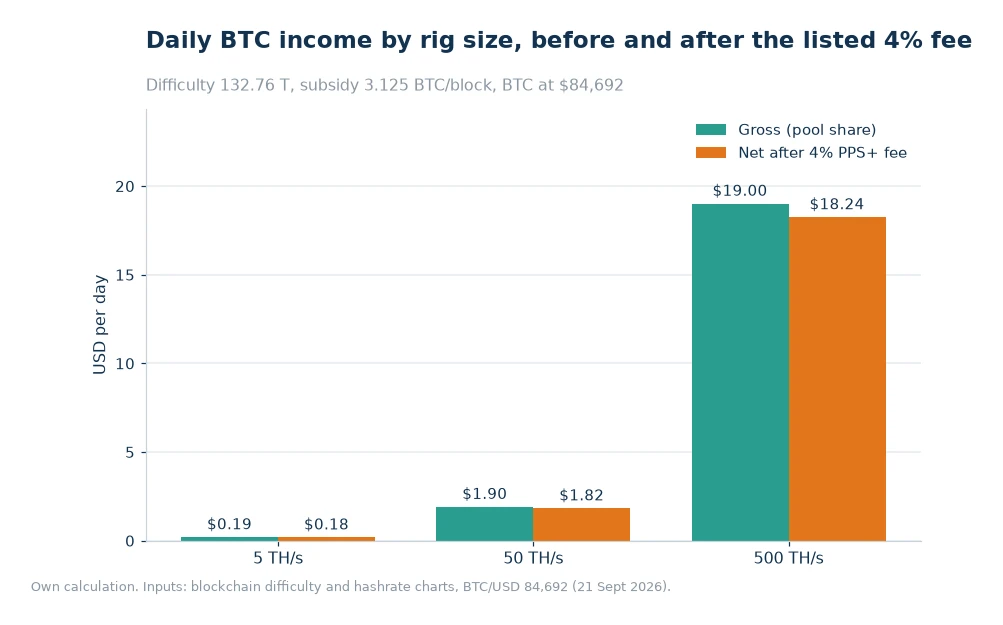
Suppose a 500 TH/s miner earns 0.0002243 BTC of gross output a day. At $84,692 that is $19.00. After the listed 4% fee on the block-reward component, roughly $18.24. Now hold the value constant and change the settlement asset: $19.00 buys about 0.32 LTC at $59.32, about 0.0727 BCH at $261.48, or roughly 460 KAS at $0.04130647.
The fee structure is what makes this a decision rather than arithmetic. The listed rates are not a single haircut, as ViaBTC's own fee breakdown explains, because a 4% figure that applies to the block-reward component and a 2% figure that applies to the much smaller transaction-fee component are not additive in practice.[2] Miners who treat the pair as one number usually misprice small hashrate by a wide margin.
| Settlement asset | Reference price (USD) | Amount per day | What you are actually deciding |
|---|---|---|---|
| BTC | 84,692 | 0.0002243 BTC | Keep the mining revenue in its native unit; fewest conversions |
| BCH | 261.48 | ≈ 0.0727 BCH | Settle in the asset you already spend or invoice in |
| LTC | 59.32 | ≈ 0.32 LTC | Useful where the mining and the spending chain are the same |
| KAS | 0.04130647 | ≈ 460 KAS | Longer holding, larger unit counts, same underlying value |
Every row is the same $19.00. Only the number of conversion events differs, and each conversion is a point where fees, spread and timing can leak value.
Where miners get it wrong
Chaining conversions. Mining a chain you do not hold, converting to Bitcoin, then converting again into the asset you spend from costs two spreads instead of one. Auto Conversion exists precisely to collapse that path.
Reading the fee as one number. A 4% and a 2% that apply to different components are not a 6% total, and they are not a 4% haircut on everything either. Check which component your payout method charges, and on what.[1]
Ignoring merged-mining output. A machine pointed at LTC is also earning DOGE, and an estimate that misses the auxiliary chain understates the position. Any calculator worth using handles merged output explicitly, which is why ViaBTC's own profit calculator takes it into account alongside coin price, difficulty, PPS rate and valid hashrate.
Sweeping too often. Moving a small balance off-exchange-style every week can cost more in withdrawal minimums and spread than the balance earned. Mining payouts themselves carry zero fee, so the cheapest habit is to let the account accumulate and move value when the amount justifies it.
Leaving the decision unexamined. Payout currency is a setting on the account, not a law of nature. Reviewing it when a coin's liquidity or your own spending pattern changes takes ten minutes.
A checklist you can run today
- List the assets you actually hold or spend, and the invoice currencies you cannot avoid.
- Set the payout asset to match, so each unit of mining income converts at most once.
- Check the payout method and read the listed fee per component rather than a headline rate.
- Confirm the settlement cadence and any withdrawal minimum, because a payout you cannot move is not yet money.
- Re-run the estimate with current difficulty any time the network changes materially; use the numbers on the mining pool dashboard as your reference for what the pool is actually producing.
- Keep a monthly note of what you mined, what you converted and at what rate, so drift shows up early.
Frequently asked questions
Do mining pools cost anything to join?
Joining is free; the pool earns from its fee on settled payouts, which appears as a percentage of the block-reward and transaction-fee components.
Can I mine more than one coin at the same time?
Yes. Merged mining lets a machine secure a parent chain and an auxiliary chain together, and multi-coin pools support switching between chains without moving hardware.
Does choosing a different payout currency change what I earn?
Not the expected value. Your share of network hashrate sets the ceiling; the settlement asset only decides how many conversions that value passes through before you can use it.
Decide once, then stop thinking about it
Write down the assets you hold, set the payout currency to the first one on that list, and let the account do the conversion. Review the decision when your costs or your plans change, not every week. The miners who lose value here are rarely making a dramatic mistake — they are simply converting three times when once would have done.
Data and sources: ViaBTC pricing page[1] and the ViaBTC fee breakdown article[2]; network difficulty, hashrate and coin prices read from public chain data and market feeds on 21 September 2026. Figures are illustrative and move with difficulty, price and hashrate — read on 21 September 2026.